They say write what you know and a lot of authors out there write about characters who are writers. That part is not strange. What is strange is how these characters portray writing in books to a degree that makes me wonder: Am I the weird one? Do I just have a really strange writing journey that is outside of how most people operate?
I mean, yes, but also I don’t think it’s that far out of the ordinary.
There are some patterns I’ve noticed. This may just be in the books I read, and I need to read about more fictional writers, but this is what I’ve seen in a lot of the stories I come across.
They are in their 20s/30s and writing their very first book
This happening once in a while wouldn’t be that strange, but I keep coming across women 1Almost always women who have always wanted to write a book and are in a place where they can start doing that because of the plot. How is it always your first book? Did none of you spend late nights writing embarrassing self-insert fanfiction in high school? Maybe a pile of books you wrote nearly to completion? The most they have is half written manuscripts that never felt right to them and I do not understand it.
It is always a book
More minor, but there’s other fiction formats than a novel. You can write short stories. Poetry. Novellas. Weird anthology series. Hell, scripts for comics, games, television, or movies. 2Male characters are more often writing television and movie scripts, I will note. Books makes sense because that’s what the author writes, but these writers rarely ever even consider another format. That’s probably because of the next point.
Their first book will be published in the end
This is your first novel ever. I can excuse the plethora of writers in these stories who are also working in literary agencies who understand what agents are looking for and know the traditional publishing process intimately. These people know what sells and, even though their journey is always framed as a passion project, those writers could know how to write for publication. The rest of these writers, though, not all of you are getting a book deal out of your first foray.
It’s romance or literary
Let someone write hard scifi! Let them buy a sword for research into their fantasy world fight scenes! It’s because that is what the genre of the book they exist in is, 3I know, I really need to pay more attention to the genre tags on books before I pick them up but genre is never a consideration. Maybe there’s a thriller author in a thriller book, but that seems to be as close as things get. I finally read one book where the writer is writing a romance with a fantasy element, but that part is so quickly glossed over with none of the nonsense of spending days trying to build a magic system that makes sense before deciding this is a soft magic system so you can get back to writing already.
They are writing by hand
By. Hand. My hands hurt just reading about it. I remember several people over the years writing their Nano novels by hand and the cramping and hand pains they endured, plus the pens giving out at key moments of their stories. It’s not a bad exercise to try, and maybe as their first book it’s actually a good thing to make them have to type up their book after hand writing it as their first editing pass, but how are all of these characters getting these books done without a single hand cramp?
They don’t have other writing friends
This absolutely happens with some writers, but every time? I think in one book the love interest was also a writer, but they acted more as a rival, which is a shame. Long conversations about how to make different parts of a book work between writer characters could be such a fun way to explore character dynamics or even to include some foreshadowing. I mean, if you have a romance author trying to make the romance work, it could be an easy way to drop in some hints around how the third act break up is resolved in an opening scene, you know?
I write writers too
All of this to say I am not exempt from doing some of these things as well, but reading about it so often is making me think a lot harder about the writer characters I have. They are getting writer friends, diversifying their genres and formats, and some won’t be published at all. And I will be sure to make myself a bingo card for the next book I read with a writer in it.
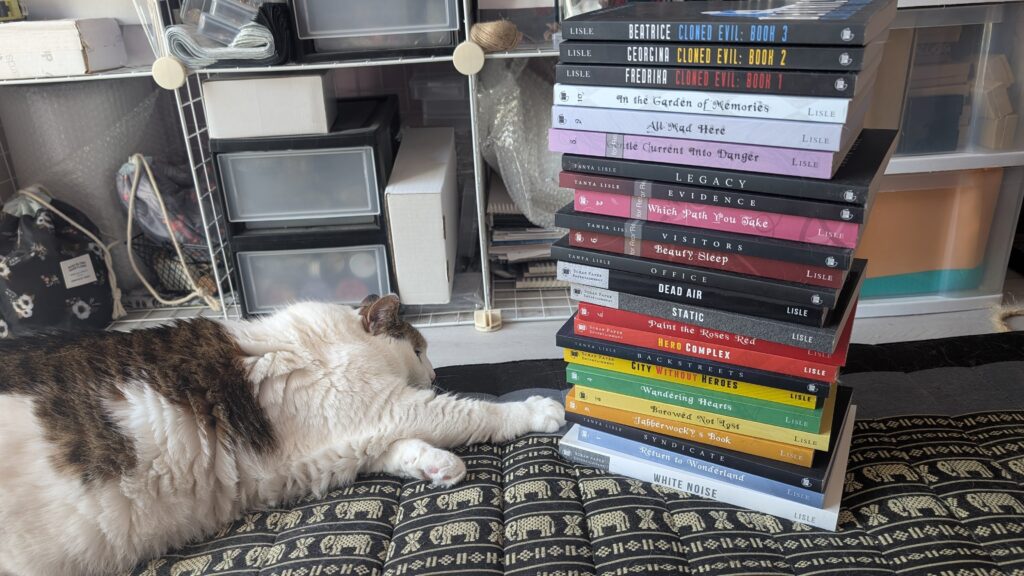
After months of writing for just ten minutes a day, I have finally managed to write a book for the first time in four years! The last draft I finished was back in 2021 when I write the Cloned Evil trilogy. It’s been so good to finally feel somewhat normal again.
It has been an adjustment to writing like this. I used to churn out a first draft in a week, letting myself get completely lost in the story and working off of a plot outline. I tried a lot harder with that first draft, hoping that it was structurally sound and actually including all of the bits that I don’t really enjoy writing. It was easier to do because I was writing for hours at a time, which meant that I would get back to the fun stuff soon enough.
But with only ten minutes a day, a lot of this went out the window and I went back to how I used to write. No plot, no time spent on the boring stuff, a lot of skimming over the bits that I didn’t have fully figured out. I forgot how much fun pantsing is. Plus, it’s not like I only spent ten minutes on the story a day, just ten minutes writing. I would write at the very end of the day, and then go to sleep with story ideas spinning through my head.
Which, incidentally, means I slept a lot better when I wrote.
There has been nothing that’s made me feel more like myself in the last several years of being chronically ill than finishing a book. It will be a long time before it’s ready for anyone else to read, but I’m so excited to be able to get back to working on the things I love again.
I got covid back in May 2022, which means I have been dealing with this illness for three years now. I’m pretty sure this means by even the most conservative estimate I am unlikely to ever recover from it and this is just what my life will be like now.
And I’m okay.
I’m at a point where my symptoms are predictable, which is honestly the best thing for me. I can generally tell how much I can do in a day, when I am pushing myself too far, and how long I will need to recover when I go over my energy limits. I may not be able to be spontaneous anymore, but I can make plans and have short outings to grab coffee with friends once a month. I’ve figured out how to get groceries and the things I need and there’s a lot fewer doctor’s appointments lately draining the little energy I have. Plus, with the weather getting better, my body is more cooperative and I am starting to go outside for quick adventures again.
And I’m writing again! Which, honestly, is the best thing to happen in a long time for me. I can only handle about 10 minutes a day and have had to put in place some child locks to keep myself from going over, but it means that I’m finally working on a new book. I don’t write like I used to and I am definitely not churning out a trilogy in a month anymore, but I am writing and I am happy.
With the weather getting better, I’m hoping to get over a functional hour a day and more than 10 minutes continuously on a task before I need a break. They’ll probably be used on getting the garden together, bothering the cat, and setting things up for myself when I inevitably get over confident and trap myself in bed again. My world is smaller, but I’m okay and I’m getting pretty good at finding little joys in life.
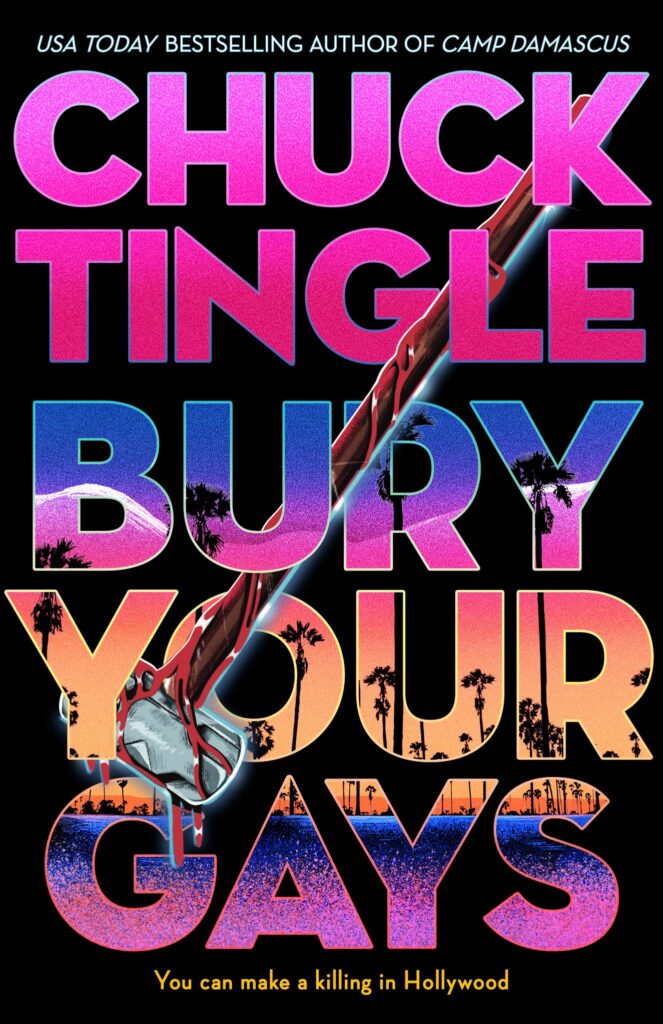
It’s been a while! Health took a bit of a dip and I had to unfortunately take a break from books and reading, but what better way to pick things back up again with a not-meme book from an author that I know almost entirely from the memes, Chuck Tingle! Although I think his erotica might have been a bit easier on the brain… (Not an insult, my brain is just part of the health struggles)
We follow Misha, a horror writer whose television series is going to culminate in a finale where the two female leads are going to make their relationship explicit at last, and for them to be happy. Unfortunately, the studio demands that ending change to either a tragedy or make them straight. When Misha refuses, the monsters he created in the past begin appearing and coming for him.
As an author, the first chapter hit especially hard for me. Woven into the themes of limited queer representation in media is also this element of algorithm-based media and replacing humans with AIs that will be able to make the perfect media based on what will be the most profitable. I believe this was written before OpenAI and Deepseek, but their existence certainly made that part of the narrative resonate with me a hell of a lot more.
I did admittedly spend a lot of the story thinking that some elements could have been collapsed together or various elements could be tightened up right up until the end. A lot of things came together and, well, asexuality as a plot point is a favourite underutilized thing I love to see.
Overall it was just a really fun book. My expectations were probably too low going into it, and I think I would have loved it just as much if I were expecting a lot more. I don’t think the heavy-handedness of the narrative takes away from the story, and I just really enjoyed it. If it sounds remotely interesting to you, check it out!
It is Long Covid Awareness Day and my original post was making me mad so I thought something a little lighter was in order: How a debilitating chronic illness cured my corporate burnout. This post was written while properly pacing, which means in 5 minute sprints over the course of over a week, so expect some disjointedness.
The job
For those who aren’t familiar with me as a 9-5 employee, I was a tech worker from 2008 to 2023 working primarily in B2B software. I started out developing websites and, as the tech stacks became more complex and segmented, I was pushed further and further into the front end. Nearer to the end I moved over into the product side of things, eventually settling into a senior product design role. Skills-wise this was a good fit. I like research, numbers, and trying to make things better for the people who are actually using the products I’m working on. I also tend to think longer term and bigger picture, and I felt like over on the product side of things that was something I could do.
Happiness-wise, this turned out to be awful because none of those things I liked or felt were ever prioritized. In broad strokes, quick wins were more important than making sure we weren’t making more tech debt and things that made money now were much more important than making sure the users were able to do their jobs. I also had trouble saying no to things and believed my boss when I was told this workload was only temporary (Lie), so I ended up overworked. When I did finally start saying no it was too late. I had set the expectation and just kept getting more and more work with less and less impact.
Add in office politics, my projects getting randomly canceled after I had put in a ton of work, general work chaos (Layoffs and changing plans every couple months is great for your employees), and the part where the company said they prioritized one thing and did something completely different and burnout was inevitable.
The coping mechanisms
Writing has always been an outlet for me. While I was working, I also wrote, rewrote, edited, and published at least 3 books a year. Looking back on it now, I can recognize that this output was largely a result of needing both a way to relieve the stress of the day job and to have a place where I felt like I did have some feeling of control. I was not creating things for a business or for profit, but because it was personally fulfilling. It also made me very happy, but there was also the escapism and the fact that I could put in the work and see the results.
This did also mean that I never really had any downtime. I considered all of the writing to be my down time because I felt better after I worked on those projects, but it was still work. A lot of work. I have been publishing since 2012 and writing for even longer, so I spent a lot of years never really resting.
Cue Long Covid
I got Covid in May of 2022. By June, I knew something was wrong. It took a very long time for me to get a doctor agree with me enough to check that I met the criteria for Long Covid, and even longer before a different doctor agreed to send me for testing for it to confirm.
I won’t go into the diagnosis process and whatnot at this point. The important part for right now is that it’s a big chronic illness with a wide variety of possible symptoms. For me, this presents primarily as ME/CFS with PEM, as well as POTS. I also get out of breath a lot, and have have a small collection of other miscellaneous other things that come and go or that I haven’t found a proper name for yet. I haven’t quite been able to explain “my blood feels weird” to a doctor yet, but that’s also probably not important for this topic.
It has, however, meant that I am unable to work any longer. Trying to work and maintain my workload was making my condition even worse so I have been off of work for a while now as I try to recover.
But what does that look like?
As much as I’d love all the medical terms to explain it, it’s really confusing to understand what has practically changed about life as a result of it. My world is much smaller now and I am physically very limited in ways I can’t quite describe, but this is as close as I think I’m going to get with my brain how it is now.
Action
Before
After
Number of “functional” hours in a day
12-14
1-2
How many times I need to stop and catch my breath going up the stairs
0
2
How long I can hold a conversation before a headache starts
Multiple hours
5 minutes
How long I can sit in a chair before getting dizzy or start developing a headache
Multiple hours
5-10 minutes
How long I lie in bed resting because I can’t do much else
Did not do this
6 – 8 hours
How long I can write (Or concentrate on any singular thing, really) before my brain goes fuzzy
So many hours
5 minutes
How long I need to lie down and zone out after a 5 minute writing session
Never happened
At least 30 minutes
How much I could walk before I start to get out of breath
Could walk for an hour continuously with good shoes
End of the block if I go slowly
How long it takes before I can get out of bed and do things after I go get coffee with a friend for an hour
No time at all
3 days
How Long Covid cured burnout
Long Covid is a condition that requires rest. It’s not really that new as I understand it–Plenty of other things trigger similar conditions. It’s just not a sexy enough condition that we’ll fund the research, and so self management is really all we have. And self management means rest and to a certain extent it also means removing yourself from society to unlearn all of the things that modern society values because society and western work culture despises rest. You need to focus a lot on getting your body to get into and stay in rest mode so that it can recover from the chronic stressors on your body caused by chronic inflammation and other things that we’re still learning about.
That just happens to also be how you recover from burnout.
I take breaks now
The first thing you learn about managing chronic fatigue is that you have to rest. I thought resting was just not moving and I could do that very well. True rest, though, means letting your mind be quiet, letting your emotions be still, and letting your body stop for a while.
No longer being in a chaotic work environment (Because I am physically unable to work) completely removed my emotional stress. I no longer had anxiety and I was suddenly able to handle all of the other things in my life with ease.
Quieting the brain was a lot harder and took more work. My brain is naturally very busy. When it’s not being filled with stress thoughts about my job, it is thinking about story ideas, plans for ways to change up my house, thinking about new recipes that I could try, or any number of other things that I’ve become spontaneously curious about at any given moment. I love losing myself in a book or long form content of some kind or researching random things, and it turned out that this continues to be the biggest drain on my energy.
Now, though, I physically can’t do that anymore. If I concentrate for more than five minutes on anything, I start having a very hard time focusing on it. If I push to continue to concentrate on it, I will develop a headache. If I push through the headache, no matter how much medication I take, it will turn into a migraine. This means that I cannot think too much about anything. My body has trained me to let my brain go quiet, or at least to maintain my attention on much lighter matters.
I can’t dwell on things
In the same way that I cannot focus on anything positive or fun, I also cannot dwell on any of the negative things either. My old habit of spiraling has been trained almost entirely out of me at this point because, again, my brain goes fuzzy and then reacts with pain. On top of that, negative emotions are very draining on my limited energy, so I’ve had to work to let a lot of things go because these things are now very much not worth spending the energy on.
On the other hand
I’d be remiss if I didn’t also mention that I cannot get too happy about things either. This hasn’t just been being trained out of negative emotions, but out of extreme emotions in both directions. I just had a lot more negative ones as a result of burnout.
I’m much more confident
My confidence had been completely stripped via my day job. I didn’t feel incompetent, to be clear. I knew how to do the job and what I was doing just fine. I struggled instead with trying to understand and keep track of the changes that were happening with the company, which priorities I was supposed to keep in mind while I was making decisions, and told over and over again that what I had been told was never actually told to me. I asked for clear, direct communication and attempted to create a paper trail a few times only to be met with meetings and being told that I should need to be hand held and should be able to figure this out for myself. Do that enough and I felt like I was constantly questioning myself.
With the onset of Long Covid and all the general cognitive issues that comes with it, you’d think this would get worse. Instead, I found that when I turned to trying to navigate the medical sphere in trying to get a diagnosis and treatment I was doing just fine. Yes, I struggled to clearly state what was happening. I tried and failed with doctors to get them to let me communicate in a way that would allow me to be clear. I was told over and over again that I was dealing with anxiety and depression and other psychiatric issues and had to work hard to get someone to agree to let me go in for tests to prove I was physically impaired.
But I eventually got those tests. And time and time again, I was right.
I realized throughout this that I am fine. When put in an environment where there is a clear objective (My health improving) and procedures that can show which way to move forward, I am just fine. I had comparable obstacles in both situations, but in one where I arguably am much less experienced I was able to handle it just fine. I just don’t do well in environments with obscure goals and processes.
I have been removed from corporate life for the foreseeable future
As a result of getting sick, I am unable to work and have been more or less forcibly removed from the chaos and stress of corporate life. I no longer have to be worried every day about job security and if the things I’ve been so focused on are going to suddenly be completely irrelevant. Not being in that environment day after day and having that be the central focus of my whole life has been probably the key thing I needed to recover from burnout.
Leaving the environment causing the issue tends to resolve the issue. Surprise!
I have to acknowledge that I am in a very privileged position currently. I got sick while employed and so I have been able to rely on my job’s long term medical leave health insurance to cover my bills. My housing costs are lower than other people in my area and I have my mom come by once a week to help me with the household chores and cooking that I am not able to keep up with any longer. I’m only just starting to have to deal with government assistance because I’ve been sick for so long and should I ever have to rely on it 100% I will probably end up dead.
I also have to mention that I am not someone who ever really identified with my job. I was a person who did the job, the job was never part of my identity. It was something I learned to socially introduce myself with, but if anything I have always identified more with my hobbies than my career, which also made this a lot easier for me than it might for other people.
Some other perks
It’s not just developing some skills and new perspective that it’s helped. While I’m still trying to put a positive spin on not being able to leave bed most days, I can come up with some other positives.
I got an ADHD diagnosis
I’ve known since around 2017 that I probably had ADHD, but was told by me doctor that if I didn’t get that diagnosis as a kid, it wasn’t ADHD but anxiety. In the process of trying to convince them that I was dealing with a physical health issue I ended up getting not one but two medical professionals including a specialist to agree that yep, it’s definitely ADHD. I can’t do stimulants as a result of the Long Covid, but it’s been great to have that validation and the ability to understand why certain things are harder for me, as well as figuring out how to change my life around so that it works better for my brain instead of continuing to try and force myself to do things the “normal” way.
Which was, as it turns out, was huge drain on the limited energy reserves. If your brain doesn’t work that way, I’ve become a big fan of finding a way to work with your brain rather than against it.
I’m okay with sounding dumb
One of the final books I managed to write and publish before I got sick was Fredrika, about a woman who speaks with a valley girl accent due to an accident in her childhood. She is sure that people can’t understand her and speaks quickly when she speaks at all, though it’s more that they are caught off guard by the language and she just speaks so quickly that they don’t always follow. She can speak like everyone else, but it takes a lot of concentration and gives her horrible headaches.
As it turns out, this is a very apt metaphor for how I felt when I talked at the start of all of this. The brain fog made it hard to find the right words at the right time and I spoke even faster than I did before because I could feel the thought leaving my head when I started speaking. Concentrating and focusing on what I was saying to try and make it sound right gave me headaches and made all of my other symptoms worse. I was certain that only nonsense was coming out of my mouth and it was incredibly frustrating.
But unlike Red, I learned to accept that I don’t sound the same and don’t care anymore. I am, in fact, a little annoyed that people understand me so well because from my perspective it is just gibberish coming out that has somehow escaped my mouth as a coherent thought that I have quite frequently forgotten by the time my lips stop moving. It is now simply the strange way in which I communicate and if the people around me seem to understand me fine, then I am no longer going to stress about the word choice being the most correct, or even making sense. If I’m not then it’s on them to ask me again.
I’m re-prioritizing life
Because I have a lot more time and my brain doesn’t really let me dwell or spiral on the negatives any longer, I can really focus on figuring out life. Not being able to do most things in life really shows what things I miss the most and what I want to spend my limited energy on. The things that bring me joy and satisfaction are things like telling stories and being creative. The friends who check in have become so much more important. I also still really like figuring things out and telling people all about the things I figured out.
Making super awesome features for B2B SaaS products is pretty low on the priorities list now.
Will these things always be important? Who knows. Some day I will probably have to return to work, health issues or no. I am smart and capable, and that will be a concern for when it comes up. Right now, I’m just focusing on my health and taking it one day at a time for the first time since I started working. The future is unpredictable and, for the first time in a long time, I’m okay with that.
A bit of a late start, but welcome 2024! This would typically be the time I set new intentions and goals for the new year, but this year we are going to do something a little different.
For me, this is the year of rest. I have finally gotten diagnosed with Long Covid after dealing with the condition since June of 2022 and there is no real cure besides resting myself back to health, both mentally and physically. That means I can’t push myself to achieve the most I can, set my outrageous goals, publish everything and do all the things on top of a full time job. It means I have to take it easy.
It means I have to learn how to take a break.
And that sucks.
But it’s also been a long time coming. As much as I wish it didn’t take a major illness to do, it really was only a matter of time before I was going to burn right out and be forced into some kind of break anyway.
I am still myself, though, and that doesn’t mean I am going to completely stop everything. It just means adjusting what I’m doing so that I am not incurring major setbacks or triggering crashes.
And so, I have a few promises to myself in terms of this blog for this year:
I will allow myself to take days or weeks on a post and not try to stick to a schedule
I will continue to review books and post date those for Fridays, but will also be comfortable about missing weeks if I just cannot keep the brain together enough to read
I will talk more about the things happening in my life
I will also talk about the things I am working on, even if “working on” doesn’t result in anything tangible
I won’t stick to any themes or topics, and am free to talk about things outside of writing or jewelry or anything else
As it is, this blog took me 3 days to write, and it’s not even that long! Be proud of me. I’m already trying and hopefully this is a good step on the long road to recovery.
And I’ve actually done it! I’m reading my books a chapter at a time, starting with Return to Wonderland. On alternating weeks, I’ll also have a behind the scenes episode talking about things like what got cut from the stories, elements that never quite made it in because of the way the stories unfolded, and generally looking back on the series as a whole.
I have been publishing since 2012, putting out several books a year for a decade, and took the last year off of publishing. At first, that was an intentional choice. The actual plan was to use the year to try out a few stories that I wasn’t sure about and give myself the space to not like something and still have something that I could get ready for publication the year after.
That plan fell apart pretty much immediately. Between the flood and getting sick with a chronic condition that I have not yet recovered from (I might one day, but it’s going to take a while) I have had to learn a lot about rest and figure out how I can still consider myself an author when I am not writing. Or when I am incapable of writing.
The thing I’ve come to realize in my time of forced rest is that the way I was going before, with time spent working almost every evening on writing the next book and making sure I was always busy with another new project, was probably not sustainable in the long term. I have needed the rest for a while, and finally circumstances allowed me to take it.
And rest has been hard. It’s not something that comes naturally to me by any means. I want to do things constantly, but this rest and the new habits that I’m building as a part of it are good for me in the long term, regardless of health. Spending hours on the computer churning out 5000-10000 words in a day in order to meet deadlines may mean that the stories get done faster, but ultimately that rate is not good for me.
I had my productive decade. And now I am entering an era of rest. Expect books much more slowly, as I try and find a new balance with where I’m at now.
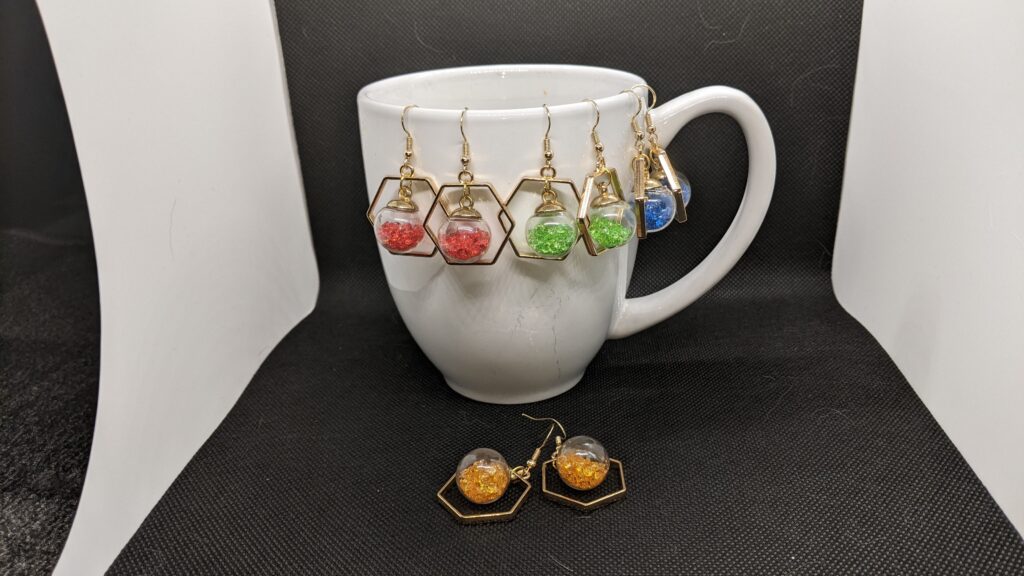
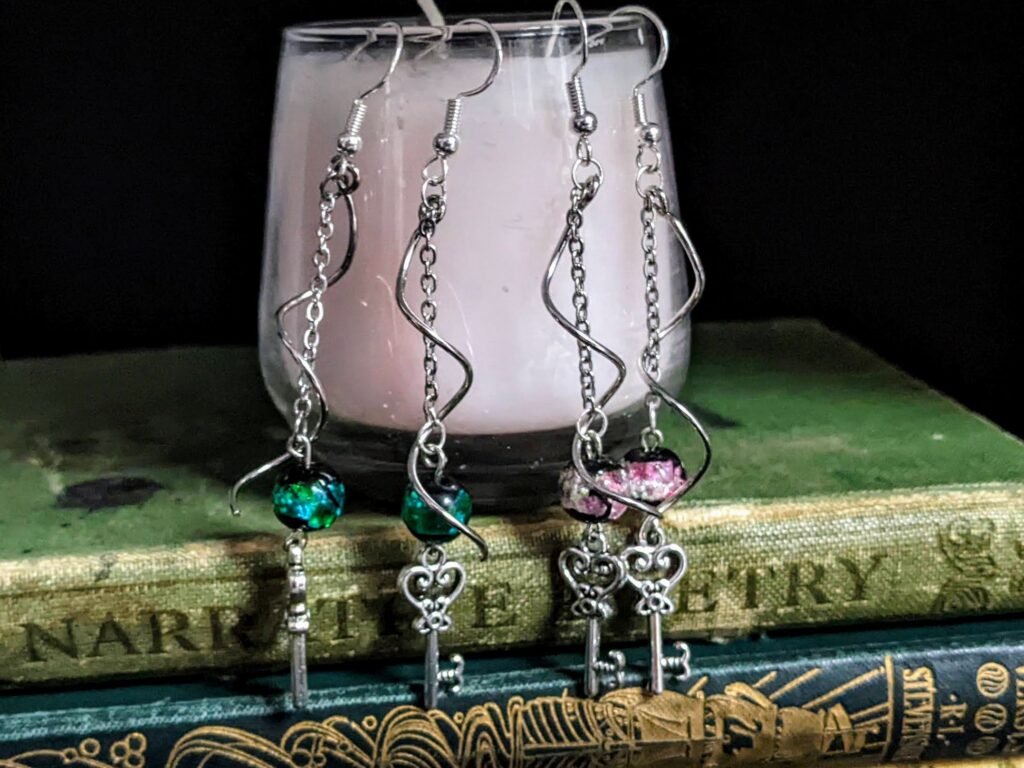
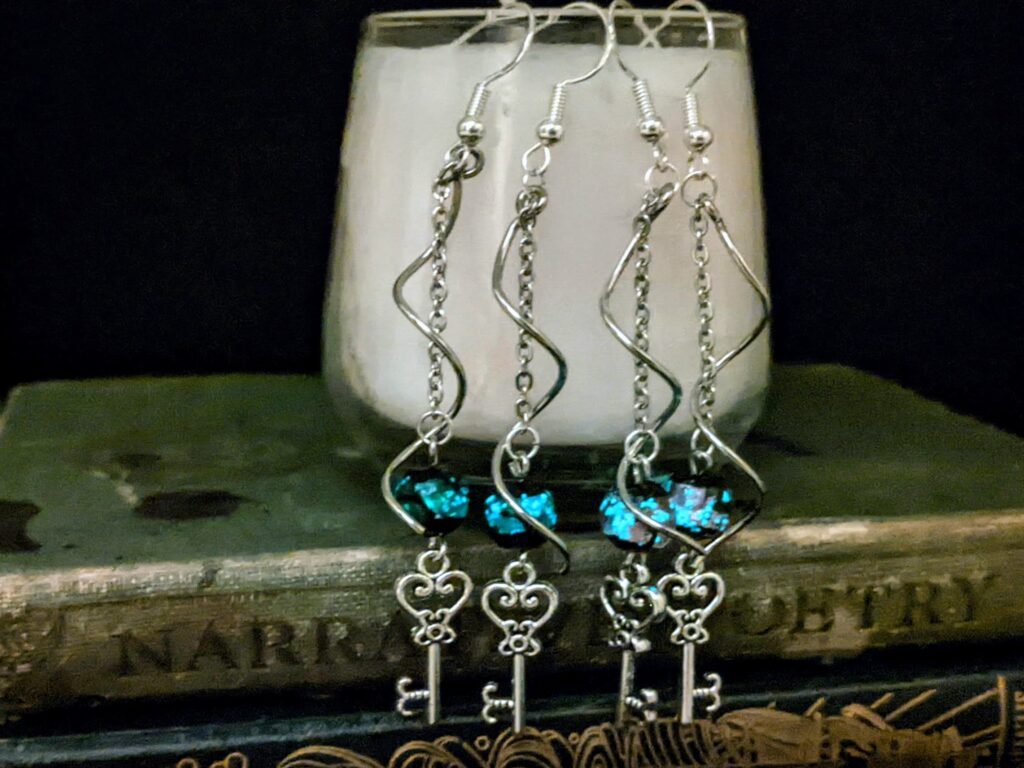
Another month and another set of new things that I’ve gotten out into the world! Slowly, I’m pulling all of this stuff together!
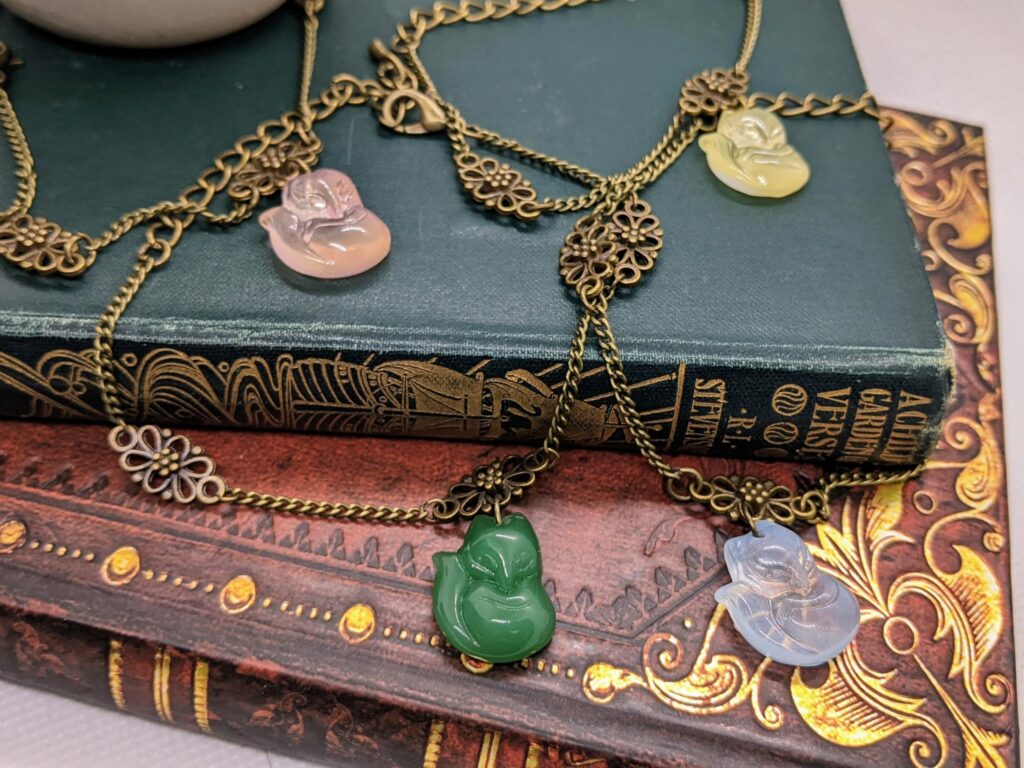
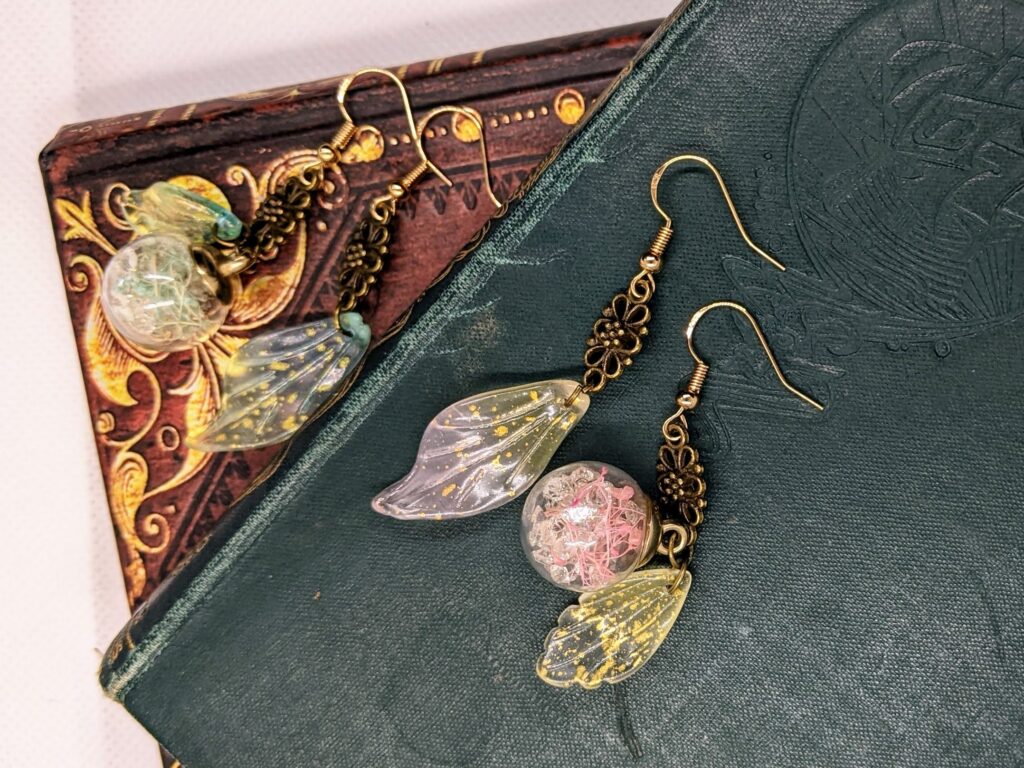
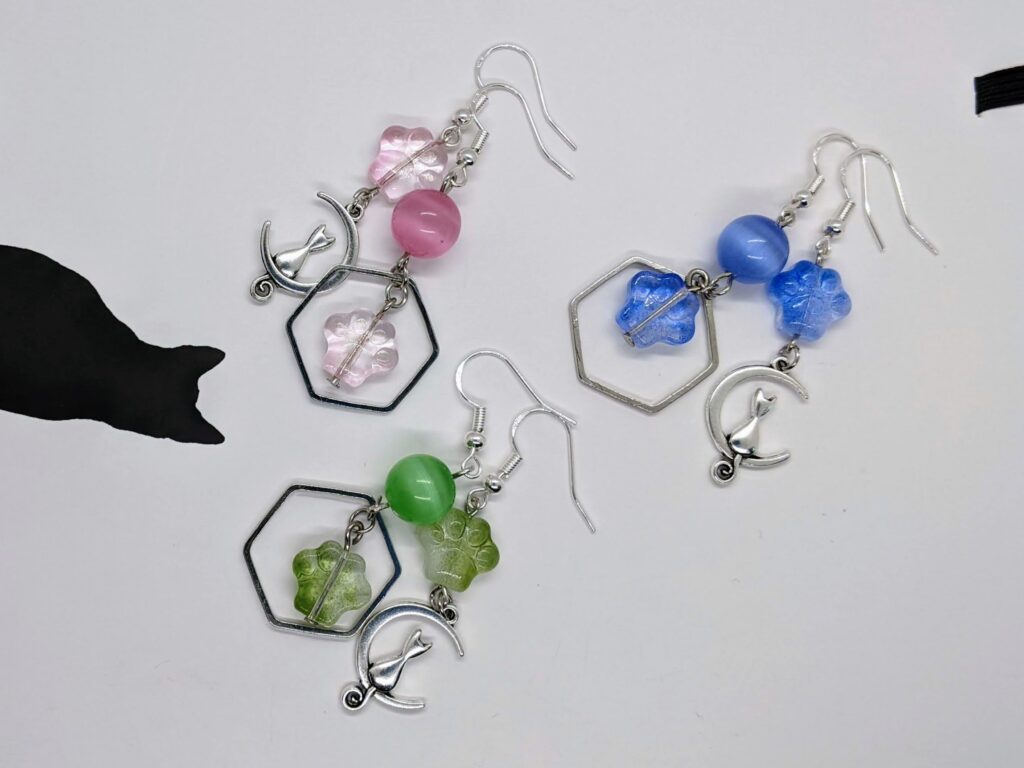
Scrap Paper Trinkets
I’ve finally got the instagram account set up for this, so do follow me there for more up to date releases of the new products that come out closer to when they come out!
These items have been released on both of these shops:
I’m releasing a new workbook in a couple weeks! This is a guided workbook to help with character development, and to generally get you a more rounded character. Tentative date is April 10, so check back soon!
Also, due to some requests from people in my life and online, I’m also starting to document and write out some of the processes I have implemented to help get my life and my writing together. I’ll be putting them all on Gumroad, along with also releasing some digital versions of the worksheets from the workbooks I’ve made so far.
February is just about gone and here’s what’s happened so far!
Scrap Paper Trinkets
I’m going through a bit of a rebrand! I’m splitting the handmade stuff off into a seperate account, since it seems that the people who like the jewelry and handmade stuff are not the people who are interested in the books and author-related stuff. I’ll still be posting everything here, but nonetheless!
These items have been released on both of these shops:
And I’ve continued to post some extra stuff on Medium, but I think I’m going to start putting some of that content here first. Still, I would really appreciate it if you followed me over there as well!